Draw Mohrs Circles Stress in X Direction Is 0
Mohr's Circumvolve for 2-D Stress Analysis
You can know almost the theory of Mohr's circles from any text books of Mechanics of Materials. The following two are adept references, for examples.
ane. Ferdinand P. Beer and E. Russell Johnson, Jr, "Mechanics of Materials", Second Edition, McGraw-Loma, Inc, 1992.
2 . James One thousand. Gere and Stephen P. Timoshenko, "Mechanics of Materials", Third Edition, PWS-KENT Publishing Company, Boston, 1990.
The two-D stresses, and so called airplane stress trouble, are usually given by the three stress components s ten , s y , and t xy , which consist in a two-by-ii symmetric matrix (stress tensor):
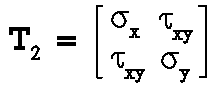
(one)
What people commonly are interested in more are the 2 prinicipal stresses s 1 and southward 2 , which are the two eigenvalues of the two-by-2 symmetric matrix of Eqn (1), and the maximum shear stress t max , which can be calculated from s 1 and s 2 . Now, see the Fig. 1 below, which represents that a state of airplane stress exists at point O and that it is divers past the stress components southward 10 , s y , and t xy associated with the left chemical element in the Fig. 1. Nosotros propose to determine the stress components s x q , s y q , and t xy q associated with the right element after it has been rotated through an angle q nigh the z axis.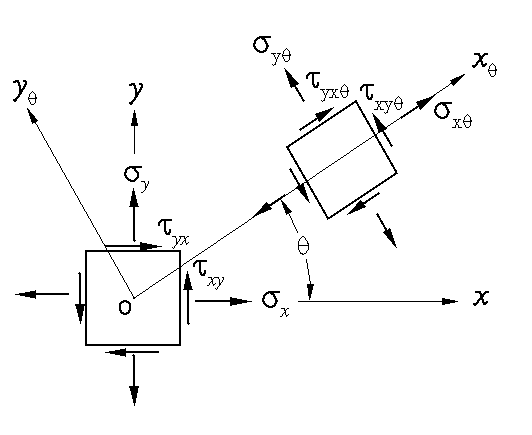
Then, we take the post-obit relationship:
(2)
and(3)
Equivalently, the above two equations tin can be rewritten every bit follows:(iv)
and(five)
The expression for the normal stress s y q may be obtained past replacing the q in the relation for s 10 q in Eqn. 3 past q + 90 o , it turns out to exist(6)
From the relations for south ten q and s y q , one obtains the circle equation:(seven)
(8)
This circle is with radius R 2 one thousand and centered at C = (s ave , 0) if let s = south x q and t = - t xy q as shown in Fig. 2 beneath - that is right the Mohr's Circle for plane stress problem or 2-D stress problem!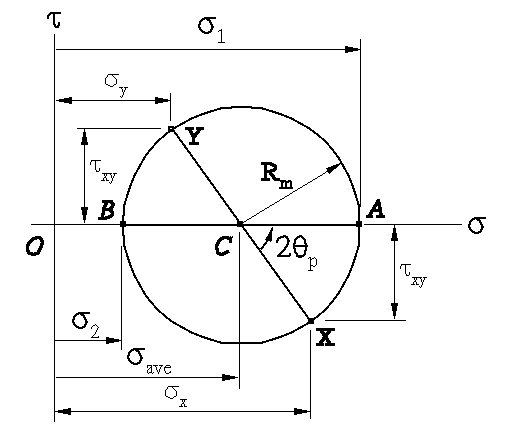
(ix)
which corresponds to the indicate at which q = 0 and the point(10)
which corresponds to the point at which q = q p that gives the master stress s ane ! Notation that(eleven)
and the point(12)
which corresponds to the indicate at which q = xc o and the betoken(thirteen)
which corresponds to the point at which q = q p + 90 o that gives the master stress due south 2 ! To this end, one tin pick the maxium normal stressess as(14)
Besides, finally one can also read the maxium shear stress every bit(xv)
which corresponds to the apex of the Mohr'south circumvolve at which q = q p + 45 o !Mohr's Circles for 3-D Stress Analysis
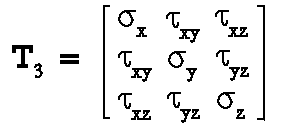
(xvi)
What people commonly are interested in more than are the three prinicipal stresses southward ane , due south 2 , and s iii , which are eigenvalues of the three-by-three symmetric matrix of Eqn (sixteen) , and the three maximum shear stresses t max1 , t max2 , and t max3 , which can exist calculated from s 1 , s two , and s 3 .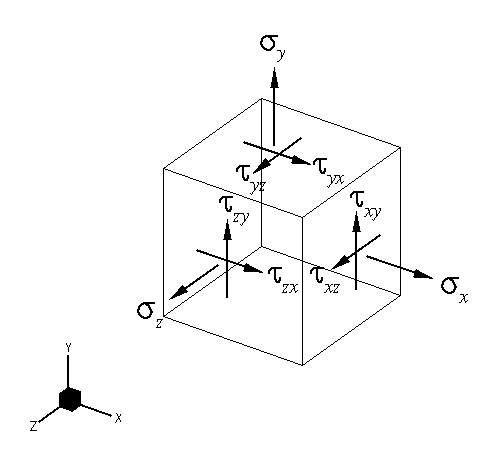
Imagine that at that place is a plane cutting through the cube in Fig. three , and the unit normal vector due north of the cut plane has the direction cosines v 10 , v y , and v z , that is
(17)
so the normal stress on this airplane can exist represented by(eighteen)
At that place be 3 sets of management cosines, n i , north 2 , and north 3 - the three principal axes, which make southward due north achieve extreme values s one , south 2 , and southward 3 - the three principal stresses, and on the corresponding cut planes, the shear stresses vanish! The problem of finding the principal stresses and their associated axes is equivalent to finding the eigenvalues and eigenvectors of the following trouble:(19)
The iii eigenvalues of Eqn (19) are the roots of the post-obit characteristic polynomial equation:(twenty)
where(21)
(22)
(23)
In fact, the coefficients A, B, and C in Eqn (20) are invariants as long as the stress state is prescribed(see e.g. Ref. 2) . Therefore, if the three roots of Eqn (20) are southward 1 , s two , and s 3 , one has the following equations:(24)
(25)
(26)
Numerically, one tin can e'er find one of the three roots of Eqn (xx) , east.chiliad. s ane , using line search algorithm, e.thousand. bisection algorithm. Then combining Eqns (24)and (25), i obtains a simple quadratic equations and therefore obtains ii other roots of Eqn (xx), e.g. due south ii and s iii . To this end, one can re-order the three roots and obtains the three primary stresses, e.g.(27)
(28)
(29)
Now, substituting s 1 , s 2 , or s 3 into Eqn (19), one can obtains the corresponding primary axes n ane , n ii , or n 3 , respectively.Like to Fig. 3, i can imagine a cube with their faces normal to n 1 , n 2 , or due north 3 . For example, i can do so in Fig. 3 by replacing the axes X,Y, and Z with n one , n 2 , and n 3 , respectively, replacing the normal stresses s ten , south y , and s z with the chief stresses s 1 , s 2 , and s 3 , respectively, and removing the shear stresses t xy , t yz , and t zx .
Now, pay attention the new cube with axes north 1 , n 2 , and due north three . Let the cube be rotated near the centrality n 3 , and so the corresponding transformation of stress may exist analyzed by ways of Mohr's circle equally if it were a transformation of plane stress. Indeed, the shear stresses excerted on the faces normal to the n three axis remain equal to zippo, and the normal stress southward iii is perpendicular to the aeroplane spanned by n 1 and northward ii in which the transformation takes place and thus, does not affect this transformation. One may therefore utilize the circle of diameter AB to determine the normal and shear stresses exerted on the faces of the cube every bit it is rotated about the n iii axis (see Fig. four). Similarly, the circles of diameter BC and CA may be used to determine the stresses on the cube as it is rotated most the n one and n two axes, respectively.
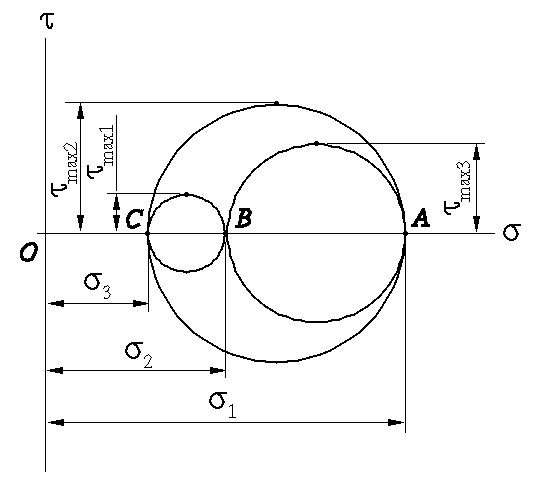
Therefore, one can obtain the maxium/minimum normal and shear stresses from Mohr'south circles for 3-D stress as shown in Fig. 4!
Note the notations above (which may exist different from other references), i obtains that
(thirty)
(31)
(32)
Note that in Fig. iv, t max1 , t max2 , and t max3 are the maximum shear stresses obtained while the rotation is almost n 1 , n 2 , and due north three , respectively.Mohr's Circles for Strain and for Moments and Products of Inertia
Mohr's circle(s) can be used for strain analysis and for moments and products of inertia and other quantities as long as they can be represented by two-by-two or three-by-three symmetric matrices (tensors).Source: https://www.engapplets.vt.edu/Mohr/java/nsfapplets/MohrCircles2-3D/Theory/theory.htm
0 Response to "Draw Mohrs Circles Stress in X Direction Is 0"
Post a Comment